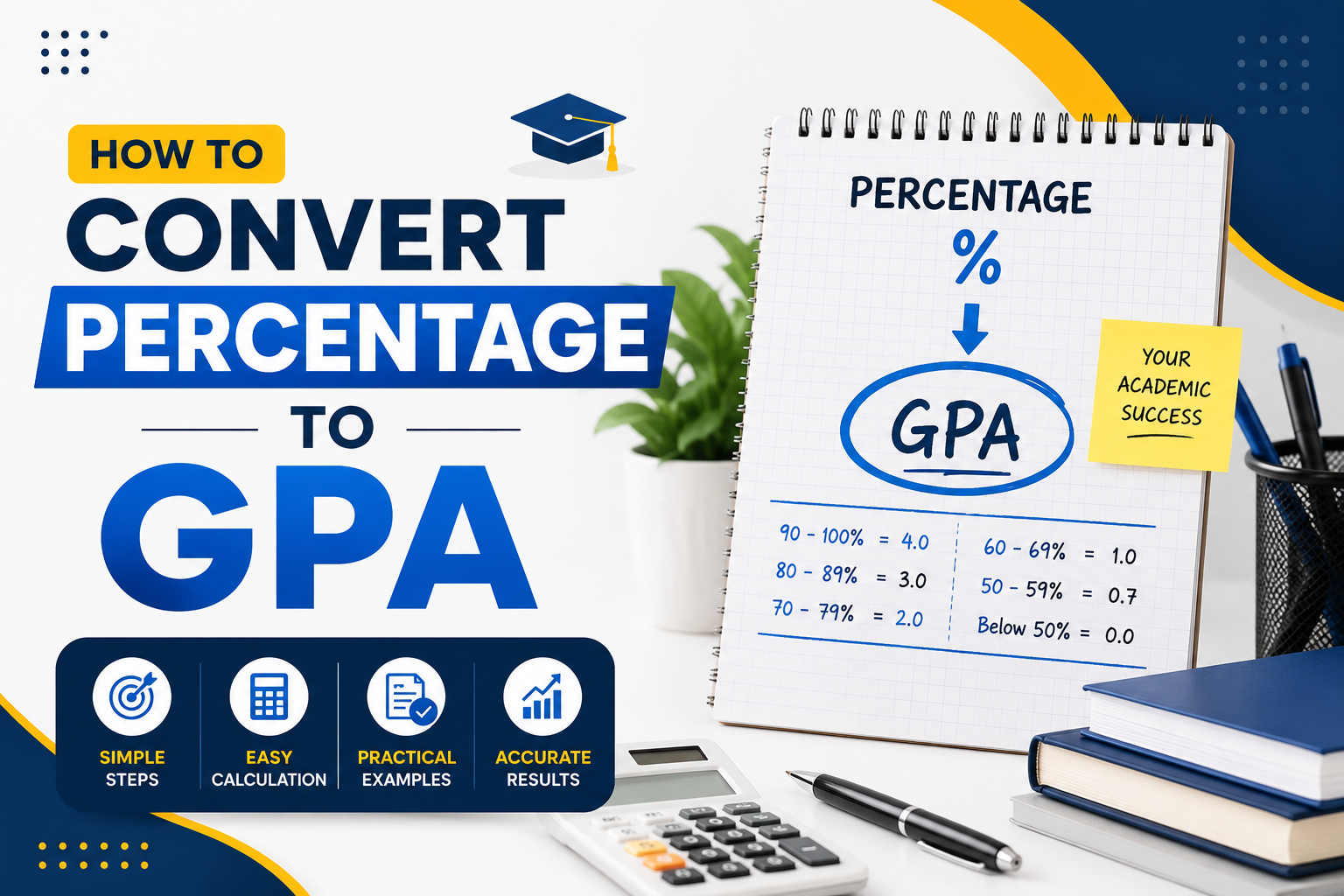
How to Convert Percentage to GPA — Complete Guide
If your school or country grades on a percentage system, but you need to apply somewhere that expects a GPA, you’ve likely run into a confusing gap. Percentage to GPA conversion trips up a lot of students, mostly because the “correct” formula isn’t always obvious.
In this guide, we’ll walk through exactly how to convert percentage to GPA across the most common scales, explain why the process isn’t always perfectly precise, and show you how to get an instant result using our free Percentage to GPA Calculator.
Why Convert Percentage to GPA at All?
Many countries, including India, Pakistan, and several others, use percentage as the default grading system. Meanwhile, the US, Canada, and a number of international universities rely on GPA.
When you apply to a university or program that uses GPA, admissions officers may ask you to convert your percentage so they can evaluate your application using their standard scale. Without this step, your application might be harder to assess fairly, since reviewers may not automatically know how your percentage compares to their grading system.
How GPA Is Structured, in Brief
To understand why percentage-to-GPA conversion works the way it does, it helps to know how GPA itself is built. Institutions using GPA typically assign a point value to each letter grade — an A might be worth 4.0 points, a B 3.0 points, and so on. Your overall GPA is the average of these point values across all your courses.
Percentage systems work differently: each subject is scored directly out of 100, and your final percentage is the average of those individual scores. Because GPA groups performance into bands while percentage measures it continuously, converting between the two always involves some approximation, even when using a well-established formula.
The Basic Percentage to GPA Formula
The formula depends on which GPA scale you’re converting to. Here are the three most common versions.
Percentage to 4.0 GPA Scale:
GPA = (Percentage ÷ 100) × 4
Percentage to 5.0 GPA Scale:
GPA = (Percentage ÷ 100) × 5
Percentage to 10.0 CGPA Scale:
GPA = Percentage ÷ 9.5
Notice that the 10-point formula is simply the reverse of the common CGPA-to-percentage formula (CGPA × 9.5). Since that’s the most widely used approach, it’s also the one we recommend using when converting the other direction, unless your institution specifies otherwise.
Step-by-Step: How to Convert Percentage to GPA
Follow these steps to convert any percentage into a GPA value.
Step 1: Identify your target scale.
Check the application, job form, or institution’s requirements to see whether they expect a 4.0, 5.0, or 10.0 GPA.
Step 2: Apply the matching formula.
Use the corresponding formula from the section above.
Step 3: Calculate.
For example, if you scored 82% and need a 4.0 GPA, the calculation is: (82 ÷ 100) × 4 = 3.28.
Step 4: Round appropriately.
Most institutions expect GPA values rounded to two decimal places, so 3.28 would typically be presented as-is, or rounded to 3.3 depending on the form’s requirements.
If you’d rather skip the manual math, our Percentage to GPA Calculator handles this instantly — just select your target scale, enter your percentage, and get an accurate result.
Percentage to GPA Conversion Table (4.0 Scale)
| Percentage | GPA (4.0 Scale) |
|---|---|
| 100% | 4.0 |
| 95% | 3.8 |
| 90% | 3.6 |
| 85% | 3.4 |
| 80% | 3.2 |
| 75% | 3.0 |
| 70% | 2.8 |
| 65% | 2.6 |
This table is useful for a quick estimate. However, for percentages that fall between these values, using the calculator is faster and more precise than interpolating by hand.
Why This Conversion Isn’t Always Perfectly Precise
It’s worth understanding that percentage and GPA measure academic performance in fundamentally different ways. A percentage reflects your exact score out of 100 in each subject, while GPA is typically based on letter-grade bands, where a wide range of percentages (say, 90-100%) might all map to the same top GPA value.
Because of this, converting percentage to GPA gives you a close, standardized estimate rather than a perfect mathematical equivalent. This is normal and expected. Most institutions understand this and accept the conversion as a reasonable approximation, provided you use a widely recognized formula.
Percentage to CGPA on the 10-Point Scale
Students converting into a 10-point CGPA system most often use the reverse of the standard CGPA-to-percentage formula. Since CGPA × 9.5 is the most common conversion, dividing your percentage by 9.5 gives you the equivalent CGPA.
For example, a percentage of 85% would convert to approximately 8.95 CGPA (85 ÷ 9.5). Some institutions instead use the reverse of the older formula, (CGPA − 0.75) × 10, which would produce a slightly different result. As always, if the conversion needs to be official, confirm the exact formula with your institution. You can read more about how different countries structure their grading systems on Wikipedia’s overview of grading in education.
Common Mistakes to Avoid
Converting to the wrong target scale. Always double-check whether the form or application wants a 4.0, 5.0, or 10.0 GPA before calculating — using the wrong scale produces a meaningless number.
Treating the result as a perfect equivalent. As explained above, this conversion is a standardized estimate. Don’t be alarmed if it looks slightly different from a conversion done by a different formula.
Skipping institutional verification. If the converted GPA is going on an official document, always check whether your target school has a preferred or required conversion method.
Forgetting to round consistently. Decide on a rounding standard (usually two decimal places) and stick with it throughout your application materials.
When You’ll Actually Need This Conversion
This conversion comes up most often in a few specific situations: applying to graduate programs abroad, submitting scholarship applications that require a GPA format, or filling out international job applications that ask for GPA instead of percentage.
It’s a good habit to calculate and keep your converted GPA on hand ahead of time, rather than scrambling to figure it out under a submission deadline. That way, you can also double-check the number against your institution’s official policy with time to spare.
Consider a practical example. A student with an 88% average applying to a US graduate program that lists a minimum GPA requirement of 3.0 might feel unsure whether they qualify. Converting the number, (88 ÷ 100) × 4 = 3.52, shows they comfortably clear the bar. Having this number ready in advance, rather than calculating it under pressure, makes the application process considerably smoother.
A Quick Recap
Converting percentage to GPA comes down to knowing your target scale and applying the right formula. Here’s the short version:
- 4.0 scale: (Percentage ÷ 100) × 4
- 5.0 scale: (Percentage ÷ 100) × 5
- 10.0 scale: Percentage ÷ 9.5
Once you know which formula applies to your situation, the calculation takes just seconds — or you can skip it entirely using the calculator.
Percentage to GPA for Scholarship Applications
Scholarship committees, especially those based in the US or Canada, often ask applicants to report their academic record in GPA format even if their transcript is percentage-based. Getting this conversion right matters more than it might seem, since some scholarships use GPA as a hard cutoff for eligibility.
If you’re applying to multiple scholarships with different minimum GPA requirements, it’s worth calculating your converted GPA once and keeping it noted alongside your original percentage. That way, you can quickly check your eligibility for each opportunity without redoing the math every time.
Frequently Asked Questions
Is percentage to GPA conversion an exact science?
Not exactly. It’s a standardized estimate based on widely accepted formulas, since percentage and GPA measure performance differently. Most institutions accept this as reasonable.
Which formula should I trust for the 10-point scale?
Percentage ÷ 9.5 is the most commonly used and widely accepted formula, but always confirm with your specific institution if the conversion needs to be official.
Can I convert GPA back to percentage using the same logic?
Yes. Simply reverse the formula, or use the “GPA to Percentage” tab on our calculator to do it instantly.
Do all universities accept self-calculated GPA conversions?
Most do, especially for informal purposes. However, for official documentation, some universities prefer conversions made through their own registrar’s office, so it’s worth checking their specific policy.
What if my percentage doesn’t divide evenly using the formula?
That’s completely normal. Most conversions result in a decimal value, such as 3.28 or 8.95. Round to two decimal places unless the application specifies a different format.
Try It Yourself
Converting percentage to GPA is quick once you know your target scale and formula — but if you’d rather skip the manual calculation, our free Percentage to GPA Calculator gives you an instant, accurate result. Just enter your percentage, select your scale, and you’re done.